
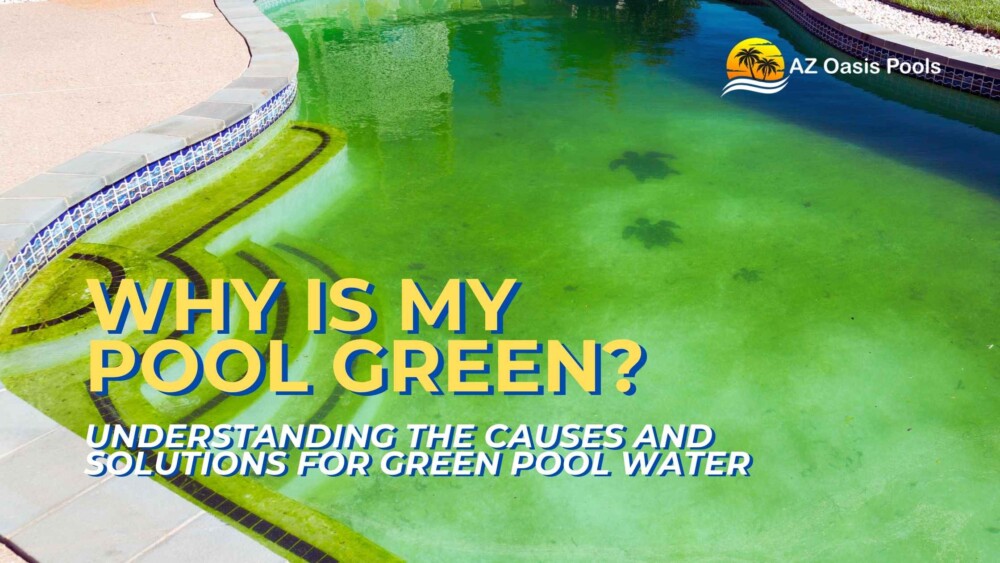
Why Is My Pool Green? Causes, Fixes, and Prevention Tips for Arizona Pools
If you’re a pool owner in Arizona, waking up to a green, murky pool can be more than just frustrating—it’s a common nightmare in our scorching desert climate, where pools serve as essential backyard oases for cooling off during triple-digit summers. Green pool water is often a sign of algae blooms that thrive in the intense heat and abundant sunlight we experience year-round. But the good news is that this issue is preventable and fixed with the right knowledge.
In this comprehensive guide, we’ll explore the root causes of green pools in Arizona, provide detailed, step-by-step DIY fixes, share proven prevention strategies tailored to our environment, and advise when to bring in professionals. Whether you’re in Chandler, Queen Creek, San Tan Valley, or anywhere in the Valley of the Sun, these insights will help you maintain crystal-clear water, save on costly repairs, and enjoy your pool without interruption.
Arizona’s pools face distinct challenges compared to those in cooler, more humid regions. With average summer temperatures soaring above 110°F and low humidity leading to rapid evaporation, pool chemistry can shift dramatically in just a few days. Dust from haboobs (intense dust storms common in the monsoon season) and pollen from desert plants such as mesquite and palo verde add organic matter that fuels algal growth. According to local water experts, Arizona pools lose 1-2 inches of water per week to evaporation alone, which concentrates chemicals and increases the likelihood of imbalances. Understanding these factors is key to tackling the problem head-on.
Common Causes of Green Pool Water in Arizona
Arizona’s arid, sunny conditions provide an ideal environment for pool discoloration. Unlike pools in rainy areas, where frequent water dilution helps, our pools rely heavily on manual maintenance to stay balanced. Here are the most prevalent causes, explained in detail:
- Algae Infestation: Green algae (chlorophyta) is the main offender, turning water cloudy or vibrant green. It reproduces exponentially in warm water—temperatures above 85°F, which is the norm for Arizona pools from May to October. Algae spores enter via wind, rainwater, or even on swimsuits and toys. Without adequate sanitizer, a single spore can lead to a full bloom in 24-48 hours.
- Imbalanced Pool Chemistry: Chlorine levels below 1 ppm allow algae to flourish, while high pH (over 7.8) reduces chlorine’s effectiveness. In Arizona, hard water from municipal sources is rich in calcium and minerals, leading to scaling and pH spikes. Phosphates from fertilizers, bird droppings, or even sunscreen residues act as algae food, exacerbating the issue. Evaporation concentrates these elements, making weekly testing crucial.
- Poor Circulation and Filtration: A sluggish pump or clogged filter lets dead spots form where algae settles. Arizona’s fine desert dust accumulates quickly in filters, reducing efficiency by up to 50% if not cleaned regularly. Variable-speed pumps, popular here for energy savings, can fail if not calibrated for our heat, leading to inadequate turnover.
- Environmental Factors: Our relentless UV radiation degrades chlorine at a rate of 50-90% per day without stabilizers like cyanuric acid. Monsoon rains (July-September) introduce acidic water and debris, while infrequent cloud cover means constant sun exposure. Additionally, nearby landscaping—think cacti or citrus trees—can drop leaves that decompose and feed algae.
- Neglected Maintenance: Skipping weekly cleanings or ignoring equipment wear (common in older pools) compounds problems. In Arizona, where pools are used year-round, even a short vacation can turn a clear pool green if automation systems glitch.
For a deeper dive into how desert climates impact water quality, the National Oceanic and Atmospheric Administration (NOAA) provides an excellent resource on arid weather patterns: https://www.noaa.gov/education/resource-collections/climate/desert-climates. This highlights why Arizona’s low humidity and high evaporation rates demand vigilant pool care.
Statistics from the Arizona Department of Health Services show that improperly maintained pools can harbor bacteria alongside algae, posing health risks like skin infections or gastrointestinal issues. It’s not just aesthetic—it’s about safety.
Here are step-by-step DIY fixes to clear a green pool.
If your pool has turned green, act quickly to prevent further escalation. These steps are designed for Arizona homeowners, taking into account our heat, which can speed up or slow down the process. Always prioritize safety: wear gloves and goggles, and avoid mixing chemicals.
- Gather Supplies and Test Water: Start with a quality test kit (digital for accuracy) to measure pH, alkalinity, chlorine, cyanuric acid, and phosphates. Ideal ranges: pH 7.2-7.6, alkalinity 80-120 ppm, chlorine 1-3 ppm, cyanuric 30-50 ppm. In Arizona’s hard water, high calcium (200-400 ppm) is normal but can complicate balancing.
- Balance the Basics: Lower pH with muriatic acid (add slowly, retest after 4 hours). Boost alkalinity with sodium bicarbonate if low. This prep step ensures subsequent treatments work effectively.
- Super-Shock the Pool: Calculate your pool’s volume (e.g., average rectangular pool: length x width x avg depth x 7.5 gallons). Use calcium hypochlorite shock at 2-3 times normal dose—about 2 lbs per 10,000 gallons. Dissolve in buckets first, then broadcast evenly. Run the filter 24/7; in our heat, shock at night to minimize UV loss.
- Brush, Scrub, and Vacuum: Use a nylon brush for plaster pools or steel for pebble finishes. Scrub every surface vigorously to break algae’s hold. Vacuum on “waste” setting to remove debris without recycling through the filter. This step alone can clear mild cases.
- Apply Algaecide and Clarifier: Add a non-foaming algaecide (polyquat or copper-based) per label. Follow with a clarifier to clump fine particles for easier filtration. Retest and adjust chlorine after 24 hours.
- Filter Maintenance and Monitoring: Backwash or clean your filter mid-process. Monitor progress daily; full clearing may take 3-7 days in severe cases. If phosphates exceed 500 ppb, use a remover.
The Centers for Disease Control and Prevention (CDC) emphasizes that shocking kills pathogens, reducing health risks: https://www.cdc.gov/healthywater/swimming/index.html. Expect to use more chemicals in Arizona due to evaporation—budget $50-100 for a full treatment.
If issues persist, they may indicate leaks or pump problems—see our detailed pool leak detection guide for troubleshooting.
Essential Pool Maintenance Checklist for Arizona Homeowners
To make prevention straightforward, here’s a handy checklist tailored to our desert conditions. Print it out and post it near your pool equipment for easy reference:
- Daily Tasks: Skim surface debris, check water level (add if below skimmer), inspect for visible algae spots.
- Weekly Tasks: Test and balance chemicals (pH, chlorine, alkalinity), clean skimmer baskets and pump strainer, brush walls and floors.
- Monthly Tasks: Backwash or clean filter, add stabilizer if cyanuric <30 ppm, shock pool lightly (1x dose), vacuum thoroughly.
- Seasonal Tasks (Pre-Monsoon/Summer): Deep clean equipment, trim nearby vegetation, install or check pool cover, test for phosphates.
- Annual Tasks: Professional inspection, drain and acid wash if needed, upgrade to energy-efficient gear.
Following this list can cut algae risks by 80%, based on industry standards from the Pool & Hot Tub Alliance (PHTA): https://www.phta.org/.
Prevention Strategies for Arizona Pools
Beyond the basics, proactive measures are vital in our climate. Start by upgrading to automated systems such as chemical feeders or saltwater chlorinators, which maintain consistent levels even in hot conditions. Use pool covers—not just for winter but daily—to block UV and reduce evaporation by up to 90%. In Arizona, opt for mesh safety covers that allow rain through while keeping debris out.
Control environmental inputs: Position windbreaks (fences or plants) to minimize dust, and use phosphate-free fertilizers in your yard. For eco-conscious owners, the Environmental Protection Agency (EPA) recommends low-impact chemicals: https://www.epa.gov/saferchoice/products?search=pool%20chemicals.
Regular professional tune-ups catch hidden issues; in our state, where groundwater is mineral-heavy, this prevents scaling that harbors algae.
Research from the University of Arizona’s Cooperative Extension underscores algae’s link to poor water management in deserts: https://extension.arizona.edu/pubs/az1399-2023.pdf.
When to Call Professionals for Green Pool Help
DIY works for mild cases, but pros handle complex ones efficiently. At AZ Oasis Pools, our specialized green pool cleanup service uses commercial-grade tools for rapid results—often in 1-2 days. We include thorough testing, equipment checks, and long-term advice.
Call us if:
- Water stays green post-48 hours.
- You notice equipment malfunctions.
- Health symptoms arise from exposure.
- You’re dealing with black or mustard algae variants.
Serving Ahwatukee, Chandler, Gilbert, and beyond—visit our locations page for details.
Why is my pool Green?
A green pool in Arizona is a solvable setback, not a disaster. You can keep your pool inviting by pinpointing causes such as algae and imbalances, following DIY fixes, adhering to our maintenance checklist, and implementing prevention tailored to our desert conditions. Consistent care not only saves time and money but also ensures safe, enjoyable swims. Struggling with green water?
Download our free pool chemistry cheat sheet or contact AZ Oasis Pools for expert help today. Your clear pool awaits!
Trackbacks/Pingbacks