

A green pool looks like a disaster, but most can be brought back without draining, if you work in the right order and use enough chlorine for your water. Arizona makes this harder than the national how-to guides admit: our heat burns off chlorine fast, monsoon storms dump dust and debris overnight, and the stabilizer that protects chlorine from the sun slowly builds up until shocking stops working. We’ve cleared Valley pools since June 2006. Here’s exactly what to do, how much chlorine it really takes, and when draining is the smarter move.
Quick answer
- Get the pump running and the filter clean.
- Test free chlorine, pH and cyanuric acid (CYA, or stabilizer).
- Brush every surface.
- Raise chlorine to a shock level matched to your CYA (about 40% of the CYA reading), and hold it there.
- Run the filter around the clock, clean it as pressure climbs, and vacuum dead algae.
- Stop when the water is clear and chlorine holds overnight. If CYA is very high, dilute it first.
Don’t swim until the water is clear and chlorine and pH are back in normal range.
Why Valley pools turn green so fast
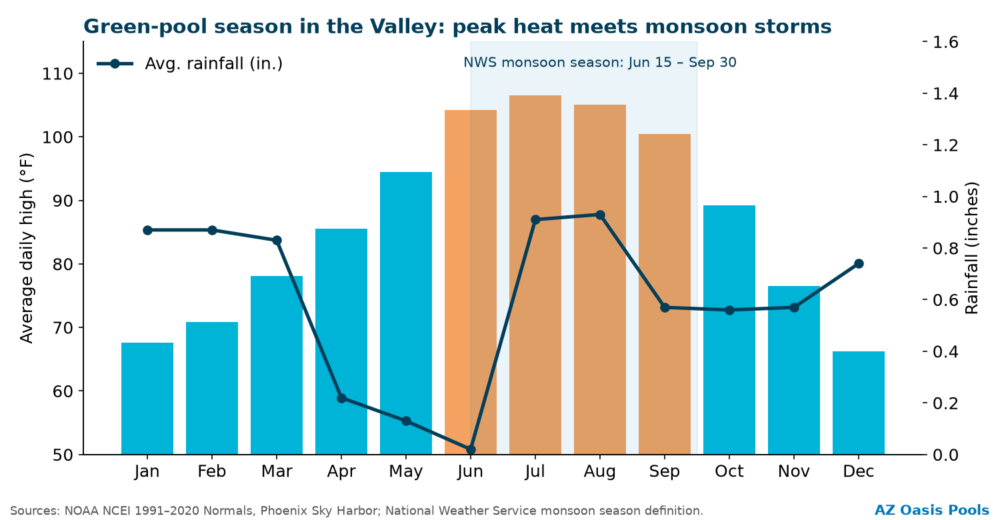
Phoenix averages about 111 days a year at or above 100°F, with June through August averaging 25–29 such days each (NOAA 1991–2020 normals). July and August are also the wettest months of the summer, inside the National Weather Service’s official monsoon season of June 15 to September 30. Heat and UV use up chlorine quickly; storms add dust, leaves and organic matter that use up even more. A pool that’s fine on Monday can be green by the weekend if chlorine drops to zero.
The usual causes are:
- Chlorine ran out. The most common cause by far: a missed chlorine dose, an empty floater or a chlorinator that stopped working.
- Stabilizer (CYA) is too high for the chlorine level. More on this below.
- Poor circulation. A pump that isn’t running long enough, a clogged basket or a dirty filter leaves dead spots where algae starts, usually in corners, on steps and behind ladders.
- Storm debris. A dust storm or rain dumps organic matter that consumes chlorine.
For a deeper look at causes, see Why Is My Pool Green?
Step 1: Check the equipment before adding chemicals
Chemicals can’t work in water that isn’t moving. Empty the skimmer and pump baskets, confirm the pump is running and primed, and check the filter’s pressure gauge. If it reads well above its normal clean pressure, clean or backwash it now. Dead algae will clog it fast once you shock, so start with a clean filter. Top off the water if it’s below the middle of the skimmer opening.
Step 2: Test the water, including CYA
Test free chlorine, pH and CYA. Most green pools test at or near zero free chlorine. Bring pH into the CDC-recommended 7.2–7.8 range before shocking, because chlorine works better at the lower end. The CYA number is the one most guides skip, and it’s the one that decides how much chlorine you’ll need.
Why stabilizer (CYA) decides how much chlorine it takes
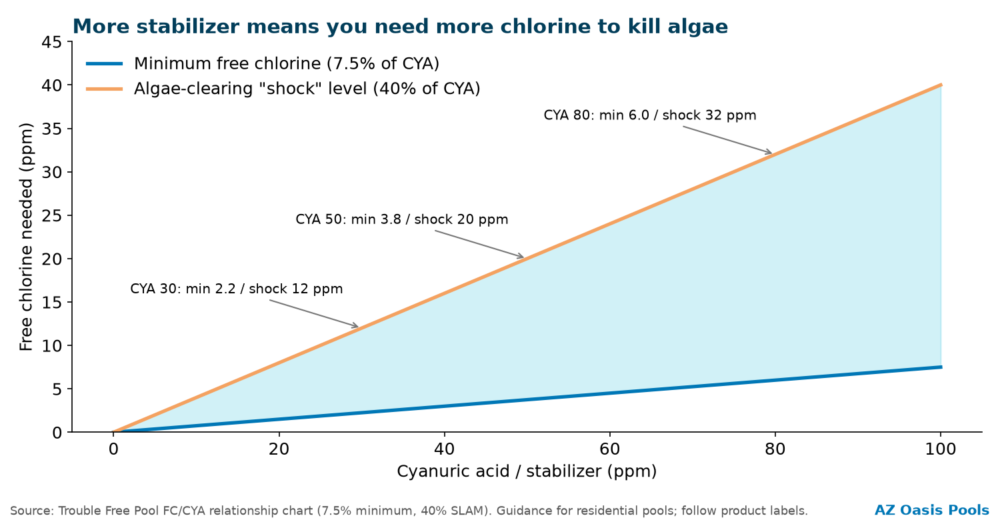
Cyanuric acid protects chlorine from the sun, which matters a lot in Arizona. But it also holds part of the chlorine in reserve, so the more CYA in the water, the more chlorine you need to get the same killing power. The widely used FC/CYA guidance from Trouble Free Pool sets:
- Minimum free chlorine at about 7.5% of your CYA level, and
- Algae-clearing (“SLAM”) level at about 40% of your CYA level.
| Your CYA (ppm) | Minimum FC (ppm) | Shock level to clear algae (ppm) |
|---|---|---|
| 30 | ~2 | ~12 |
| 40 | 3 | 16 |
| 50 | ~4 | 20 |
| 60 | ~5 | 24 |
| 80 | 6 | 32 |
This is why a pool can “have chlorine” and still turn green. A few ppm of chlorine is plenty at low CYA and not nearly enough at high CYA. Chlorine tablets and pucks add CYA every time they dissolve, and CYA doesn’t evaporate or break down in normal use. The only practical way to lower it is to replace some of the pool water with fresh water. For context, the CDC’s Model Aquatic Health Code (2024 edition) treats a public pool whose CYA-to-free-chlorine ratio exceeds 45:1 as an imminent health hazard, and caps CYA at public pools at 90 ppm.
Step 3: Brush, then shock
Brush the walls, floor, steps and corners so algae is exposed to the chlorine. Then raise free chlorine to the shock level for your CYA. Add chlorine in the evening, when the sun isn’t burning it off. Retest every few hours while you’re awake and add more to hold the shock level. A green pool uses chlorine fast, so a single dose rarely finishes the job.
Step 4: Filter, clean the filter, vacuum
Run the pump continuously until the water is clear. The water usually goes from green to cloudy blue-gray as algae dies; that’s progress. Expect filter pressure to rise quickly as dead algae collects, and clean or backwash whenever it does. Vacuum settled debris, ideally to waste on sand and DE systems so it doesn’t go back through the filter.
Step 5: Know when you’re done
Keep holding shock level until the water is clear and chlorine holds steady overnight. Trouble Free Pool’s completion checks are combined chlorine of 0.5 ppm or less and an overnight chlorine loss of 1 ppm or less, along with clear water. Then let chlorine drop back into its normal range for your CYA, rebalance pH and resume normal care.
Treat it or drain it? A decision table
| What you find | Our usual recommendation | Why |
|---|---|---|
| Light to medium green, CYA moderate, equipment working | Treat | Shock-and-hold usually clears it without losing water |
| CYA very high (shock level impractical) | Partial drain and refill, then treat | Dilution is the only way to bring CYA down |
| Can’t see the bottom, heavy debris, swamp smell | Have it assessed; often drain and clean | A chlorine wash or acid wash can be faster than weeks of treating |
| Staining that remains after the water clears | Drain and clean, possibly acid wash | Treatment won’t lift some stains |
| Pump or filter not working | Fix equipment first | Treatment fails without circulation |
| Peak summer heat and a plaster or pebble pool | Get advice before draining | An empty pool exposed to extreme heat risks surface damage |
Troubleshooting: “I shocked it and it’s still green”
| Symptom | Likely cause | Fix |
|---|---|---|
| Green again a day after shocking | Shock level too low for the CYA; chlorine not held | Test CYA; raise chlorine to 40% of CYA and keep it there |
| Chlorine vanishes overnight | Algae and organics still consuming it | Keep brushing and holding shock level |
| Turned cloudy, won’t clear | Dead algae not being filtered | Clean the filter, run continuously, vacuum to waste |
| Algae keeps returning in one corner or on steps | Dead spot in circulation | Brush that area daily; check return jet direction |
| Chlorine reads fine but water is green | High CYA making that chlorine level ineffective | Test CYA; dilute if very high |
| Brown or rust-colored water after shocking | Possibly metals reacting with chlorine | Stop and call us; it needs a different treatment |
Monsoon and vacation playbook
After a dust storm or monsoon rain: skim right away, empty baskets, check filter pressure and test chlorine the same day. Storm debris consumes chlorine quickly, and rain can dilute it.
Before a summer vacation: make sure the pump timer and chlorinator are working, the filter is clean, and chlorine is at the upper end of normal for your CYA. In June through August, plan for someone to check the pool at least weekly.
The Arizona hard-water connection
Pools here lose water to evaporation constantly and are topped off with fill water that East Valley cities publish as hard to very hard. Chandler’s 2025 report, for example, lists 10.1–16.8 grains per gallon. Hard water doesn’t turn a pool green, but it builds scale in filters, which slows flow and helps create the dead spots where algae starts. If you’re partly draining to lower CYA, you’re also refreshing that mineral-heavy water.
What we check when we’re called to a green pool
We start with the equipment: pump, baskets, filter pressure and the condition of the filter media. Then we test chlorine, pH and CYA to decide whether treating or draining makes more sense, and we look for anything treatment won’t fix, like staining or a failed chlorinator. Then we talk through the options with you before we start.
Common mistakes to avoid
- Using algaecide instead of chlorine. Algaecide can help prevent algae, but it doesn’t replace shocking.
- Shocking once and stopping. Shock level has to be held until the pool passes the completion checks.
- Ignoring CYA, especially in pools that use chlorine tablets.
- Turning the pump off at night while clearing.
- Draining a pool in peak summer without advice.
Frequently asked questions
How long does it take to clear a green pool in Arizona?
It depends on how green it is, your CYA level and how well the filter is working. Light cases can clear in a few days when chlorine is held at shock level; severe cases can take longer or call for a drain and clean.
Can I swim in a green pool?
No. Algae can shelter bacteria and the bottom may not be visible. Wait until the water is clear and chlorine and pH are back in normal range.
Why won’t my pool clear after shocking?
Most often the chlorine level wasn’t high enough for the pool’s CYA, or it wasn’t held there. A dirty filter or poor circulation also stalls clearing.
How much chlorine does it take to shock a green pool?
A widely used guideline is to hold free chlorine at about 40% of your CYA level. At CYA 40 ppm that’s about 16 ppm. Always follow the product label.
Should I drain my green pool?
Usually not as the first step. Draining makes sense when CYA is very high, the pool is severely neglected, or staining remains after treatment. In summer heat, get advice before draining.
Why does my pool turn green after monsoon storms?
Storms add dust, leaves and organic matter that use up chlorine, and rain can dilute it. Test and adjust the same day as a storm.
Do chlorine tablets cause green pools?
Not directly, but they add stabilizer every time they dissolve. Over time high CYA means you need much more chlorine to prevent algae.
Will algaecide fix a green pool?
Not on its own. Chlorine at the right level for your CYA does the work; algaecide is a supporting step.
Still green, or don’t want to deal with it? Our green pool clean up service handles it, and weekly maintenance keeps it from coming back. If the filter is the problem, see pool filter repair. Call 480-694-1158 for a free quote.