
Pool Filter Repair
Pool Filter Repair Services
Keep Your Swimming Pool Sparkling with Expert Pool Filter Repair
Your pool filter traps the dust, pollen, leaves and algae that East Valley weather keeps blowing into your water. When it clogs, cracks or wears out, the water turns cloudy, the pump strains and chlorine stops keeping up. AZ Oasis Pools repairs cartridge, sand and DE filters for homes in Chandler, Gilbert, Tempe, Ahwatukee, Queen Creek, San Tan Valley and Southwest Mesa. Our technicians are AZ Oasis Pools employees, not subcontractors, and most repairs carry a 1-year warranty.
Call 480-694-1158 or request a free quote online.
Why Pool Filters Work Harder in Phoenix and the East Valley
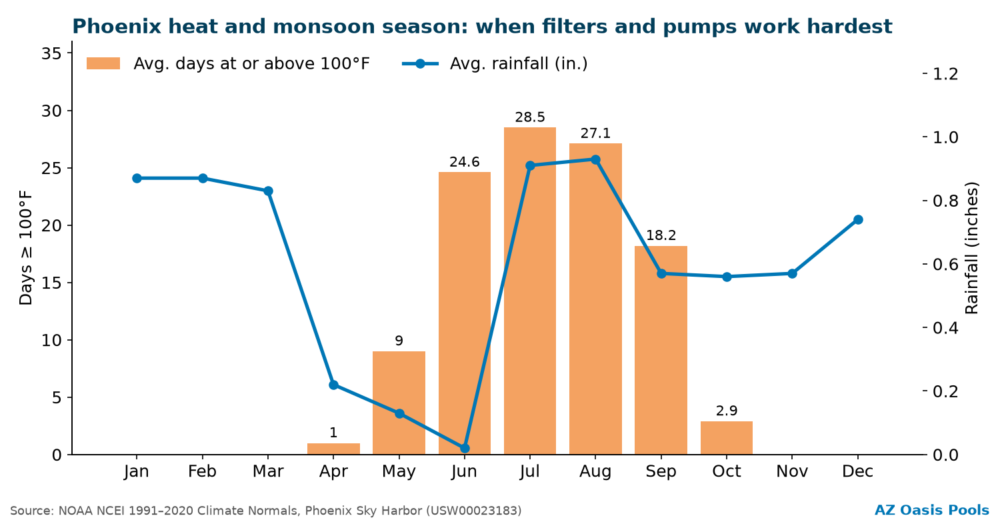
A filter in Phoenix deals with more than one in a mild climate. NOAA’s 1991–2020 normals for Phoenix Sky Harbor show about 111 days a year at or above 100°F, with 24 to 29 of them in each of June, July and August. Three local conditions add to the load:
- Heat. Warm water grows algae faster and burns through chlorine, so the filter has more to catch and your pump runs longer.
- Dust and monsoon storms. July and August bring most of the summer rain. Monsoon outflow winds and dust storms can dump a season’s worth of fine dirt into a pool in one evening, and the filter pressure jumps right after.
- Hard water. Valley tap water is high in calcium. Evaporation concentrates it, and scale builds up in cartridge pleats, on DE grids and in sand beds.
Signs Your Pool Filter Needs Repair
- Cloudy or dull water even after the pump has run all day.
- Pressure 8–10 psi above normal that comes back quickly after you clean or backwash.
- Weak returns and poor suction at the skimmer or pool cleaner.
- Sand or DE powder in the pool, which usually means a broken lateral (sand) or a torn grid (DE).
- Leaks or drips at the tank band, drain plug, multiport valve or pressure gauge.
- Air spitting from the returns or a hissing air relief valve.
- A gauge that doesn’t move or reads zero with the pump running.
- Chalky, cracked or faded plastic on the tank or lid from years in the sun.
Some of these start at the pump, not the filter. If the pump is loud, won’t prime or trips the breaker, see our pool pump repair page or pool pump troubleshooting guide.
Cartridge vs. Sand vs. DE Filters
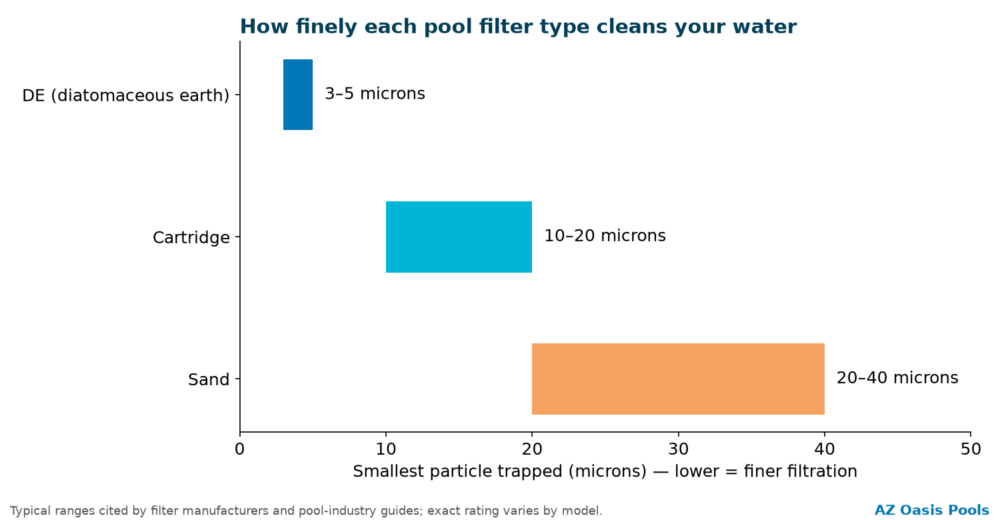
We service all three main filter types. Each one traps a different particle size and takes different care.
| Filter type | Typical filtration | How it’s cleaned | Common Arizona problems |
|---|---|---|---|
| Cartridge | About 10–20 microns | Cartridges are removed and hosed off. No backwash, so no wasted water. | Pleats load up fast with dust and calcium. Elements wear out and need replacing. |
| Sand | About 20–40 microns | Backwash through the multiport valve. | Sand gets channeled or caked with scale. Broken laterals send sand back into the pool. |
| DE (diatomaceous earth) | About 3–5 microns | Backwash, then recharge with DE powder. Periodic full teardown. | Grids tear or clog with scale. Manifold cracks. DE shows up in the pool. |
For a longer explanation of each type, read everything you need to know about pool filters.
Common Filter Problems and What Causes Them
Clogged or scaled media
Dust, sunscreen, body oils and calcium coat the cartridge pleats, DE grids or sand. Pressure goes up, flow goes down, and cleaning helps less each time. A chemical degrease or descale can bring media back. Media that’s worn out needs replacing.
Torn DE grids or broken sand laterals
When you see DE powder or sand on the pool floor right after the filter runs, something inside the tank has broken. We open the tank, find the damaged grid or lateral and replace it.
Leaking tank, clamp or valve
Dried-out O-rings, a loose clamp band, a worn multiport spider gasket or a cracked drain plug can all leak. Most are part-level repairs. A cracked tank body is not.
Air in the system
Air in the filter usually comes from the suction side: a low water level, a pump lid O-ring or a loose fitting. We trace it to the source so the filter isn’t blamed for a pump problem.
DIY Filter Care: What You Can Safely Do
These steps come from the guide that used to live on our blog, now kept here in one place. Before you open any filter, turn the pump off at the breaker and open the air relief valve.
- Write down your clean pressure. Note the gauge reading right after a professional cleaning. That number is your baseline.
- Check the gauge weekly in summer. When it reads about 8–10 psi above baseline, clean the cartridge or backwash.
- Rinse cartridges top to bottom with a garden hose and get between the pleats. Don’t use a pressure washer, which can tear the fabric.
- Backwash sand and DE until the sight glass runs clear, then rinse. After backwashing a DE filter, add fresh DE powder in the amount the manufacturer specifies.
- Inspect and lube O-rings with a silicone-based pool lubricant, never petroleum jelly.
- Empty the skimmer and pump baskets after every dust storm, then check filter pressure.
- Keep the water balanced. Balanced calcium, pH and alkalinity slow down scale in the filter.
Call a technician if pressure stays high after cleaning, if sand or DE comes back into the pool, if the tank or valve body is cracked, or if you aren’t comfortable opening a pressurized tank.
Repair or Replace? How We Decide
| Usually a repair | Usually a replacement |
|---|---|
| Dirty, oily or scaled cartridges or grids | Cracked or UV-brittle tank body |
| Worn O-rings, clamp bands, gauges, drain plugs | Repeat media failure from an undersized filter |
| Stuck or leaking multiport valve (rebuild kit) | Discontinued model with no parts available |
| Single torn grid or broken lateral | Repair quote close to the cost of a new filter |
We show you what we find, with photos, and quote both options when replacement makes sense. Filter repairs typically run about $50–$800, depending on the filter type and the repair, from a small part or a cartridge or grid replacement up to larger repairs. A new filter is quoted separately. Call for a free quote.
Our Pool Filter Repair Process
- Inspection. We check filter pressure, flow, the pump and baskets, and the water chemistry.
- Diagnosis. We work out whether the problem is in the filter itself or upstream at the pump or plumbing.
- Repair or clean. We clean, descale or replace media, swap failed parts or rebuild the valve.
- Test. We restart the system, bleed out the air and record the new clean pressure.
- Report. You get an emailed report of the work done.
Related Services
- Pool pump repair and replacement
- Green pool clean-up if a filter problem has already turned the water green
- Weekly pool service in Tempe and Queen Creek, which includes filter checks
Pool Filter Repair FAQ
How often should I clean my pool filter in Phoenix?
Go by the pressure gauge rather than the calendar. Most filter manufacturers say to clean or backwash when the gauge reads about 8–10 psi above its clean starting pressure. In the East Valley that happens more often from June through September and after monsoon dust storms, so check the gauge weekly in summer.
Which filter type is best for an Arizona pool?
It depends on the pool. DE filters trap the finest particles (about 3–5 microns), cartridge filters sit in the middle (about 10–20 microns) and need no backwashing, and sand filters (about 20–40 microns) are the simplest to run. We look at your pool size, pump, trees and how much maintenance you want before recommending one.
Why is my filter pressure high?
High pressure usually means the media is loaded with dirt, dust or calcium scale, or a return valve is partly closed. Clean or backwash first. If the pressure stays high right after cleaning, the cartridge, sand or DE grids may be worn out or scaled.
Why is my filter pressure low?
Low pressure usually points upstream of the filter: a full skimmer or pump basket, low water level, a clogged impeller or an air leak on the suction side. It can also mean a stuck gauge.
Can I clean my own pool filter?
Yes. Rinsing cartridges, backwashing sand and DE, and checking O-rings are normal owner tasks. Always turn the pump off at the breaker and open the air relief valve to release pressure before opening a filter tank. Leave cracked tanks, broken grids, laterals and multiport valve rebuilds to a technician.
Should I repair or replace my pool filter?
Clogs, worn O-rings, stuck valves and dirty or tired media are usually repairs. A cracked tank, a body damaged by UV or freezing, or a filter that is too small for your pump usually means replacement. We’ll show you what we find and give you both options.
How much does pool filter repair cost in Phoenix?
Most pool filter repairs in the Phoenix area fall between about $50 and $800. Where yours lands depends on the filter type and the repair: a small part like an O-ring or gauge sits at the low end, while a cartridge or DE grid replacement costs more, and a new filter is a separate quote. We’ll diagnose it and give you a free quote before any work starts.
Does a dirty filter make my pool turn green?
It can. When the filter can’t keep up, debris and algae spores stay in the water and chlorine gets used up faster. If your pool is already green, see our green pool clean-up service.
Get Your Filter Checked
If your water is cloudy or the pressure keeps climbing, we’ll find out why and give you an honest repair-or-replace recommendation. AZ Oasis Pools serves Chandler, Gilbert, Tempe, Ahwatukee, Queen Creek, San Tan Valley and Southwest Mesa.
Call 480-694-1158 or request a free quote online.
Our Filter Repair Expertise
Why Choose AZ Oasis Pools?
- Expertise: Our skilled technicians use hydrology knowledge for precise pool repair service.
- No Subcontractors: Every team member is a trained AZ Oasis Pools employee.
- Transparency: Detailed reports for all pool equipment repairs.
- Local Service: Serving Chandler and nearby areas since 2007.
- Warranty: Most repair services include a 1-year warranty.
If your pool filter is struggling with cloudy pool water, decreased flow, or leaks, AZ Oasis Pools is here to help. Our pool repair service ensures your pool system, including pool pumps, pool heaters, and pool lighting, stays in top shape. Call 480-694-1158 or request service online for pool filter repair in Chandler, AZ. With AZ Oasis Pools, it’s no worries—just jump in!
Weekly Pool Service: Comprehensive cleaning and filter maintenance to keep your pool ready for swimming all year long.
Expert Repairs: From pool equipment repair to filter repair, we handle it all.
Pool Automation Solutions: Optimize your system with advanced features for better efficiency and control.
The best way to avoid costly filter repairs is through regular maintenance. AZ Oasis Pools offers a variety of pool cleaning packages that include filter cleaning and inspection. By catching small problems early on, you can avoid a major headache (and expense) down the road.
Don’t Wait—Fix Your Filter Today!
If you’re experiencing filter problems like decreased water flow or cloudy pool water, contact AZ Oasis Pools for expert pool filter repair service. We’ll provide professional diagnostics, efficient filtration system repairs, and ongoing maintenance to ensure your swimming pool stays crystal clear and healthy. Whether you’re a pool owner with a filter tank issue or need help with your pool pump repair, we’re here to help.